A 1% improvement in forecast accuracy might not sound dramatic. But for a retailer managing thousands of SKUs across hundreds of locations, even small gains compound into massive operational impact:
- fewer stockouts that frustrate customers,
- less capital trapped in excess inventory, and
- the ability to automate purchasing decisions that once required constant manual intervention.
When a nationwide convenience store chain approached us to upgrade their forecasting system, we didn't improve accuracy by 1%. We improved it by 25%, while dropping the runtime to less than 5 minutes and increasing 13% on profit from inventory optimization. Here's how we built a system that transformed their supply chain operations, and how the same principles can unlock millions in value for any retailer dealing with volatile, high-velocity demand.
At its core, demand forecasting is about finding the optimal point on a cost curve. Ordering too little inventory results in stockout costs spiking. Order too much and holding costs balloon. The sweet spot, Q*, is where total cost hits its minimum.
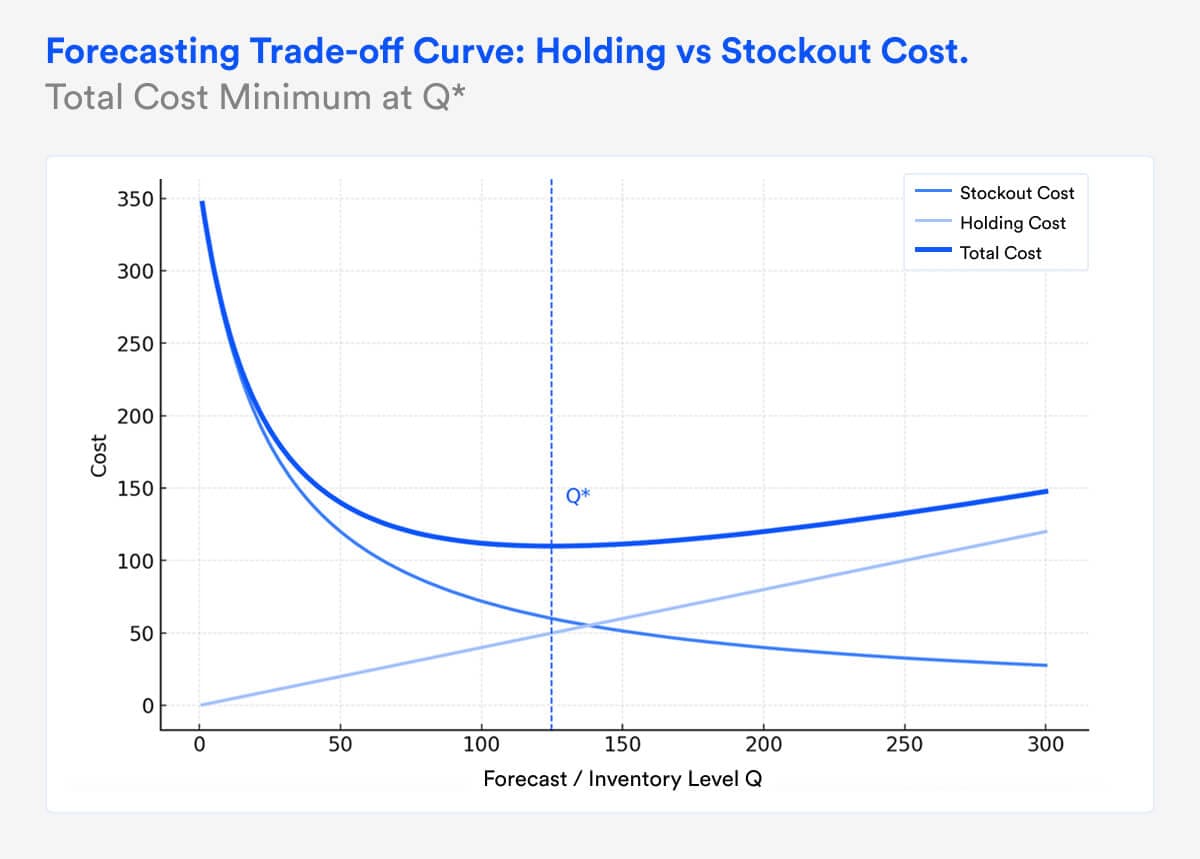
The challenge? When you're managing thousands of SKUs with volatile demand patterns, even small forecasting errors shift you far from Q*, costing millions in either lost sales or trapped capital.
Why is AI transforming the process?
Widespread AI hype has led to palpable fatigue, driven largely by the mixed results of LLM experiments. However, this LLM-centric view obscures the fact that forecasting has been supercharged by modern ML. Far from being a legacy struggle, today's forecasting offers proven impact. This creates a unique window of opportunity: leadership is eager for successful AI implementations, and forecasting provides the measurable returns necessary to justify the investment.
We partnered with a nationwide convenience-store chain, with compact shops stocked with snacks, drinks, and daily essentials, to understand how forecasting plays out in the real world.
Their existing forecasting system depended on:
- Slow, local statistical models.
- Only a small portion of the product catalog was forecasted.
- Forecast accuracy was inconsistent across products.
- The system did not scale to thousands of SKUs or multiple stores/channels.
These conditions worked against the company's objective of accelerating purchasing decisions and moving toward a more autonomous decision-making process.
In less than one month, we replaced this with a global LightGBM forecasting pipeline that learns shared demand patterns across thousands of store-product combinations. The impact was immediate:

After analyzing the data available and the forecasting implemented up to that date, we decided to abandon the one-model-per-SKU approach in favor of models that learn across the entire catalog.
Here's why that matters. Traditionally, forecasting relies on local models, where each SKU and store combination has its own statistical model. Shared patterns such as seasonality families, weekday effects, or cross-SKU correlated trends remain invisible to a purely local method.
Global models solve this by training a single model, such as LightGBM, on all SKUs simultaneously. By incorporating embeddings, calendar features, and external variables, they can identify relationships that local models miss entirely. This works especially well for large, diverse catalogs.
Semi-global models sit between the two approaches. They group products with similar sales patterns and train one model per cluster. This reduces the noise introduced when mixing SKUs with fundamentally different properties, such as mixing high-velocity staples with slow-moving long-tail items, while still enabling shared learning. Clusters can be based on sales volume, seasonality families, demand shapes, or embeddings generated from historical patterns.
Retail forecasting isn't one problem; it's thousands of them disguised as one. The underlying challenges remain the same: tens of thousands of products, each with its own trend, seasonality, demand pattern, promotional sensitivity, and mutual correlations with the rest of the catalog.
To better understand these complex patterns, we first conduct a thorough exploratory analysis of the time series. Retail datasets typically contain a wide range of demand behaviors. Some SKUs exhibit clear seasonal patterns and consistent trends. Others are highly volatile due to promotions, stockouts, weather effects, or shifts across sales channels. And a significant portion consists of intermittent series, where demand is sparse, irregular, and often appears almost random.
Understanding this landscape is crucial because no single modeling approach works well for all of them.
But even the best models depend on clean data foundations. Time series need to be consistently sampled, complete, and accurately logged, something that's far more challenging in real retail environments than it sounds. Missing timestamps, inconsistent product codes, unrecorded stockouts, and promotion data scattered across systems can degrade any model.
These are some of the reasons why our time series forecasting projects should always start with data profiling and pipeline design, not model selection. Better data today means better models tomorrow.
No two retailers face the same forecasting challenge. Product mix, customer behavior, promotional strategies, and operational constraints vary significantly across businesses. This means effective forecasting solutions require adaptation to each retailer's specific context rather than applying generic models.
Our approach starts with understanding the underlying data structure profiling demand patterns, identifying statistical clusters, and determining whether local or global models better fit the problem. We work closely with each client's operations team to incorporate domain knowledge that models alone can't capture. By combining these elements with current research in time series forecasting, we build solutions tailored to the specific patterns and constraints of each business. In this case, that approach resulted in a 25 percent improvement in forecast accuracy.
At the end of the day, demand forecasting is about balancing two costly mistakes.
- Under-forecasting means lost sales, stockouts, and disappointed customers.
- Over-forecasting results in higher holding costs, slower inventory turns, and capital tied up in products that sit on the shelf.
The goal is simple, but achieving that balance at scale requires models that truly capture your store's demand structure.
For the convenience store chain in this case study, closing that gap by 25% translated into tangible operational gains: faster decision-making, reduced manual intervention, and optimized inventory levels across their entire network.
The methodology we've outlined exploratory analysis, semi-global modeling, and clean data foundations isn't specific to convenience stores. It applies to any retailer managing complex catalogs with volatile demand: supermarkets, pharmacies, fashion, specialty retail.
Beyond forecasting, AI is reshaping how retailers tackle operational challenges year-round. From inventory positioning to real-time alerts, learn how leading retailers are shifting from reactive to predictive operations in our article on AI solutions for retail challenges.
Don't tackle everything at once. Pick a well-defined slice of your catalog, maybe your top 100 SKUs by revenue, or a single product category, and establish a rigorous baseline. Measure current forecast accuracy with proper train/test splits, then experiment with improvements on just that segment.
This de-risks the investment and gives you concrete evidence of what works before scaling. If you want guidance on how to structure these experiments or which segments to prioritize, reach out. We're always interested in talking about real forecasting problems.