From Research Paper to Production with the AlphaXiv MCP: Closing the Research-Implementation Gap
Most ML teams struggle to turn promising research papers into production code. Here's a structured three-phase approach to closing the research-implementation gap, and how the AlphaXiv MCP keeps paper research and implementation in the same window across Claude, Cursor, and other MCP-compatible AI coding tools.
Joaquin Campo, Julian O'Flaherty
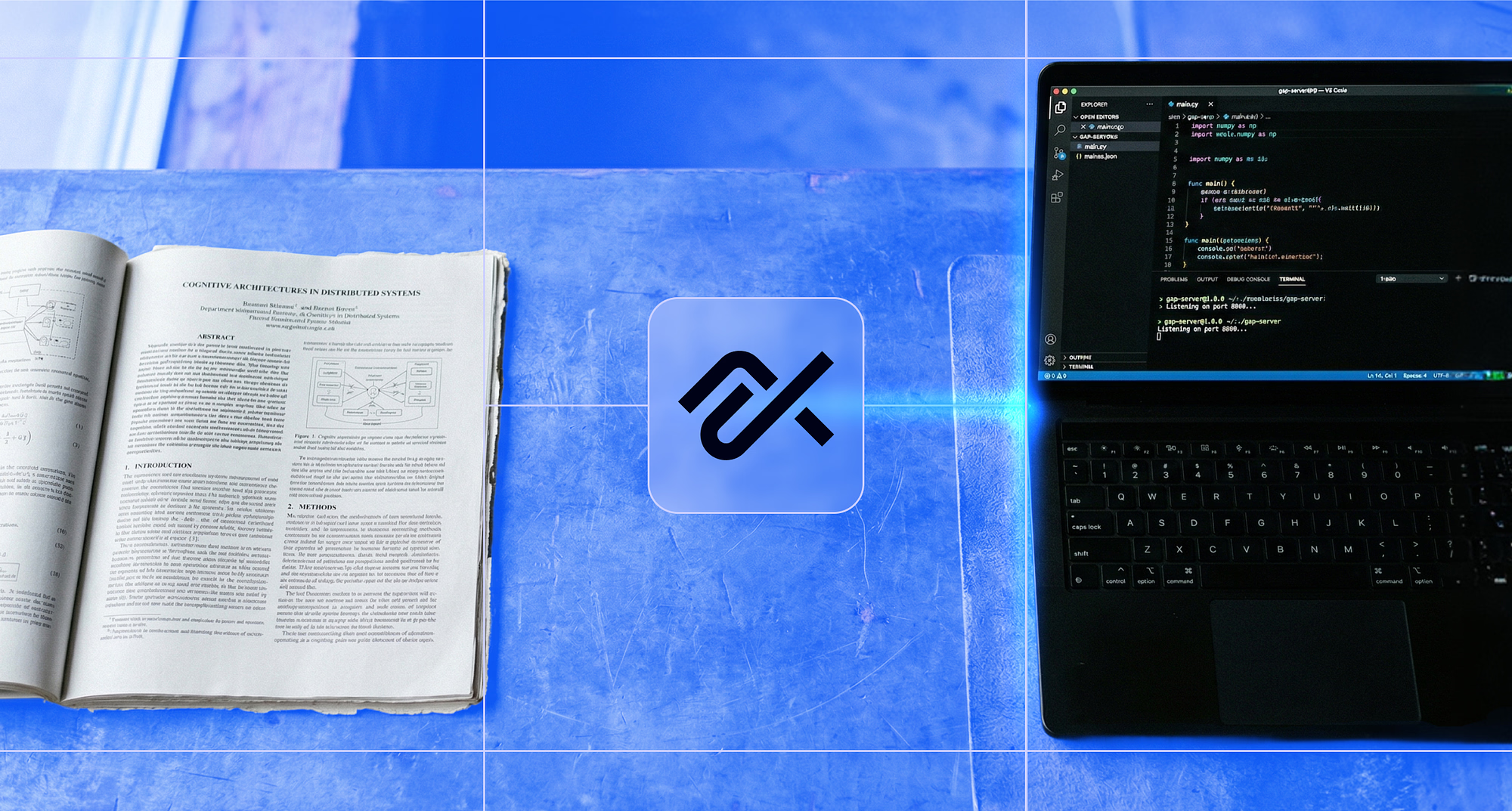
Most ML teams have a version of the same story. A research paper looks like a strong fit for a problem, the benchmarks are compelling, the architecture is clean, and sometimes the authors even release code. Then the implementation starts, and weeks pass debugging a reimplementation that barely reproduces baseline results.
A significant amount of invisible work sits between reading a paper and shipping production code: understanding implicit assumptions, adapting models to your data distribution, and making trade-offs the authors never had to consider. Across our computer vision and NLP projects, we've found that this gap is less about knowledge and more about process. Reading more papers doesn't close it. Structuring the journey between reading and building does.
The Three-Phase Approach
In practice, teams tend toward one of two failure modes: diving straight into implementation without the research that would have saved them from a dead-end architecture, or getting stuck in an endless literature review without ever writing code.
We've settled on three phases, each with a clear goal and exit criteria:
- Quick SOTA Review: Get oriented in the landscape
- ML POC: Validate feasibility through building
- Deep Refinement: Go back to research with focused questions
To make this concrete, we'll use a running example: building an object detection system for industrial inspection. The phases aren't strictly linear. Refinement often sends you back to research, but now with specific questions instead of open-ended exploration.
Phase 1: Quick SOTA Review
Goal: Understand the landscape in days, not weeks.
The temptation here is thoroughness: read every paper, understand every approach, compare every benchmark. In our experience, this consistently leads to wasted time. The purpose of the SOTA review isn't comprehensive knowledge but informed decision-making.
Scanning the Landscape
In the first few days:
- Identify the 3-5 most relevant recent papers in your problem space
- Understand the key architectural differences between approaches
- Note the trade-offs each approach makes (speed vs. accuracy, data requirements, hardware constraints)
- Pick 1-2 candidates to test
For discovery, recent survey papers are the fastest entry point. AlphaXiv surfaces community discussion around papers, which often flags known limitations before you hit them yourself, and the AlphaXiv MCP lets you query that same corpus directly from your editor (we cover the MCP in detail later in this post). Following citation chains forward (who cited this paper?) rather than backward tends to be more useful at this stage, since forward citations show how an idea evolved and where the field moved next.
For our detection example: scan recent transformer-based detectors (DETR variants1, RT-DETR2) and compare them against single-stage alternatives (YOLOv83, YOLOv104). Note that earlier transformer detectors struggled with small objects, though recent variants have narrowed this gap by combining predictions from multiple resolution levels.
Exit Criteria
The output is a decision, not a document. Something like: "We're starting with RT-DETR because of its competitive accuracy-latency trade-off, and we're aware it may need tuning for our small-object distribution."
Exhaustive benchmarking, deep dives into mathematical foundations, and reading every paper in the citation graph are explicitly deferred. That depth comes later, if it's needed at all, and when it does, it's driven by specific questions from implementation.
Phase 2: POC Implementation
Goal: Build something that works well enough to reveal what you don't know.
This is where the research-implementation gap becomes tangible. The POC isn't a prototype you'll ship; it's a learning tool. The goal is to get a baseline working on your data as fast as possible, because the real questions only surface once you start building.
Principles We Follow
- Start from existing implementations. Rewriting a paper from scratch when a reference implementation exists wastes time you could spend on adaptation. Fork it, learn from it, modify what needs to change.
- Test on your actual data early. Academic benchmarks are useful for comparison, but production data is what matters. The sooner you see how an approach handles your specific distribution, the sooner you learn where the real gaps are.
- Track what surprises you. Every gap between the paper's claims and your experience is a signal. These become the specific questions that drive Phase 3.
What the POC Surfaces
In our detection example, taking the RT-DETR reference implementation and training it on an industrial dataset immediately surfaces gaps the paper didn't address:
- Performance degrades on densely packed objects under heavy occlusion
- The default augmentations (color jitter, mosaic) are designed for varied real-world scenes. On your fixed-viewpoint, controlled-lighting setup, they produce unrealistic training samples and actually hurt performance
- Inference latency exceeds your real-time requirement by 3x
- Label noise and class imbalance in your dataset create failure modes the paper's clean benchmarks never hit
These are the kinds of findings that reveal where the research-implementation gap actually lives in a project. In our experience, it's more often in the data than in the model.
Exit Criteria (Including Kill Criteria)
A working baseline with a clear list of problems to solve.
Equally important: knowing when to walk away. If the POC reveals that the core architecture is fundamentally mismatched with your constraints not edge cases to refine but structural limitations, return to Phase 1 with a different candidate. We've killed POCs when inference profiling revealed that a model's memory access pattern made batching impossible on our target edge device. The paper's benchmarks on A100s never exposed this. The distinction matters: refinable problems are about tuning (augmentation, hyperparameters); kill-worthy problems are about architecture.
Phase 3: Deep Refinement
Goal: Return to the research with specific questions.
At this point, you're no longer browsing papers for inspiration. You're looking for answers to concrete problems, and that changes how you read.
A heuristic we rely on: for each issue the POC surfaced, go directly to the ablation tables of the top 2-3 papers. The variable you're struggling with is almost always there, because authors ablate what matters. Then read the methods section with that specific question in mind.
Hunting for Answers
- Densely packed objects: The paper's ablation tables show which encoder components matter most for dense detection. That points you to a specific architectural change (adding a higher-resolution detection head) rather than guessing.
- Domain-specific augmentation: You find that copy-paste augmentation5, pasting annotated objects onto domain-representative backgrounds, outperforms the standard augmentations that were hurting you. The paper gives you the technique; your data tells you how to apply it.
- Inference speed: Post-training quantization with calibration on your dataset closes most of the latency gap. The paper's benchmarks ran on A100s; your production hardware needs different optimization, and TensorRT profiling tells you exactly where.
Why This Phase Works
The context from Phase 2 changes how you read papers. You study ablation tables (the experiments showing what happens when authors remove or modify components) instead of skimming headline numbers. You read methods sections with specific questions, not vague curiosity. This shift from open-ended reading to targeted investigation is what makes the second pass through the literature productive.
The cycle can repeat. Sometimes a refinement leads to a new approach entirely, sending you back to a focused SOTA review. But each iteration narrows the gap rather than expanding it.
Keeping Research in the Development Flow with the AlphaXiv MCP
The methodology above works, but tooling determines how fast you move through it. The biggest source of friction across all three phases is context-switching: leaving your editor to search papers, losing your train of thought while hunting for a specific result in a PDF, or re-reading an entire paper to find the one ablation table you need.
What the AlphaXiv MCP Is
The AlphaXiv MCP is a Model Context Protocol server that connects AlphaXiv's research platform directly to AI coding tools (Claude, Cursor, or any MCP-compatible editor), so paper research and implementation stay in the same window. Instead of bouncing between a PDF reader, a browser, and your IDE, the AlphaXiv MCP exposes search, paper retrieval, and repository inspection as tools your coding agent can call inline.
How the AlphaXiv MCP Helps in Each Phase
In practice, the AlphaXiv MCP changes each phase of the research-to-production workflow:
- SOTA review: The MCP gives your agent the ability to search through AlphaXiv's research corpus quickly, right from your coding environment. Semantic search, keyword search, and agentic retrieval let you find relevant papers without switching contexts.
get_paper_contentreturns a structured AI-generated breakdown of any paper by default, so you can assess relevance without reading the full PDF. If you need the raw text, the same tool pulls it. AlphaXiv's web platform complements the MCP with trending metrics, inline community discussion, and a document visualizer for when you want to browse visually. - POC implementation: When you hit a surprise and need to check how the authors handled a specific case,
get_paper_contentlets you pull the paper directly into your coding environment. The AI-generated breakdown surfaces the key information fast, and you can request the full extracted text for deeper investigation. No more scrolling through a 15-page PDF looking for one paragraph. - Deep refinement: This is where the payoff is largest. You can query multiple papers in sequence, compare how different authors approached the same problem, and pull implementation details from associated GitHub repositories using
read_files_from_github_repository, all from within the same context where you're writing code.
The value isn't in the tool itself but in what it enables: with the AlphaXiv MCP, research and implementation become one continuous process instead of two separate activities. Reducing that context-switching overhead compounds across all three phases.
When This Approach Doesn't Apply
This framework assumes a specific problem: there is relevant published research and the challenge is turning it into working production code. Two situations where it doesn't fit:
- No directly relevant research exists. If you're working at the frontier of a problem space, there may not be a clear SOTA to implement. The three-phase structure still applies in a looser sense (survey adjacent work, build fast, refine), but the emphasis shifts toward experimentation and the SOTA review covers neighboring problems rather than your exact one.
- The research is clear but shipping is hard. The bottleneck is productionizing machine learning models (infrastructure, data pipelines, deployment), not the gap between paper and code. Different problem, different solutions.
How We Apply This at Pento
We've used this framework across client projects in computer vision, recommendation systems, forecasting, and search. The specifics of productionizing machine learning models look different in each domain, but the pattern holds.
The most common failure mode we see in teams that don't follow something like this: skipping the POC phase and spending weeks chasing model improvements when the real bottleneck is label quality, serving latency, or edge-case handling that clean benchmarks never surface.
A two-day SOTA review followed by a rapid POC on real client data surfaces the actual blockers faster than any amount of paper-reading. Our teams typically identify the critical data and infrastructure gaps within the first sprint, which turns what used to be months of open-ended iteration into focused work.
For companies evaluating where ML fits into their product roadmap, this kind of structured approach reduces the risk of the most expensive failure mode: building the wrong thing well.
Closing Thoughts
If there's one takeaway from applying this across projects, it's that the research-implementation gap doesn't close by reading papers more carefully. It closes by building something rough enough to show you what you misunderstood. The reading becomes useful after the building makes it urgent.
A simple starting point: timebox your next SOTA review to two days, start coding on day three, and write down every surprise. Then go back to the literature with those specific questions, ideally through the AlphaXiv MCP so the papers come to your editor instead of pulling you out of it. Papers you skimmed the first time around will suddenly contain exactly the implementation details you need.
If your team is navigating this gap, we'd be happy to compare notes.