MCP Turns Two: What We Hoped vs. What Actually Happened
Two years after Anthropic open-sourced MCP, it won the wiring layer and proved that wiring isn't the hard part. What we hoped for, what happened, and where the harness takes over.

Leonardo Piñeyro
CTO
On November 25, 2024, Anthropic open-sourced the Model Context Protocol with a handful of local servers and a plain pitch: stop writing custom glue between every model and every data source.1 Two years later, MCP won the wiring layer and proved that wiring isn't the hard part of shipping agents. Claude, ChatGPT, Gemini, Microsoft Copilot, VS Code, and Cursor all support it, and maintainers report over five billion cumulative SDK downloads, more than 4.5 billion in the past twelve months alone.2
At Pento, we've built with MCP across both years, in coding-agent harnesses, our AI software factory, enterprise copilots, and voice agents. Year one settled whether the standard would stick. Year two made it clear that once connectivity becomes commodity plumbing, reliability lives in the harness around it.
What we hoped a year ago
When we wrote our first-year review of MCP in December 2025, we made three bets.
We hoped MCP servers would quickly become boring, plug-and-play infrastructure backed by a verified public registry, so teams could drop in vetted third-party connectors instead of writing bespoke glue for every SaaS tool. We hoped authentication, least-privilege scoping, and human approval flows would turn into table stakes early in 2026, before security reviews stalled production launches. Most of all, we wrote that integration would become the moat and carry most of the work of moving agents from demos to production.
Two years in, the scorecard is mixed. Connectivity became commodity plumbing, operational maturity arrived later through a breaking rewrite, and tool access turned out to be the easy part.
What actually happened
The spec grew up by going stateless
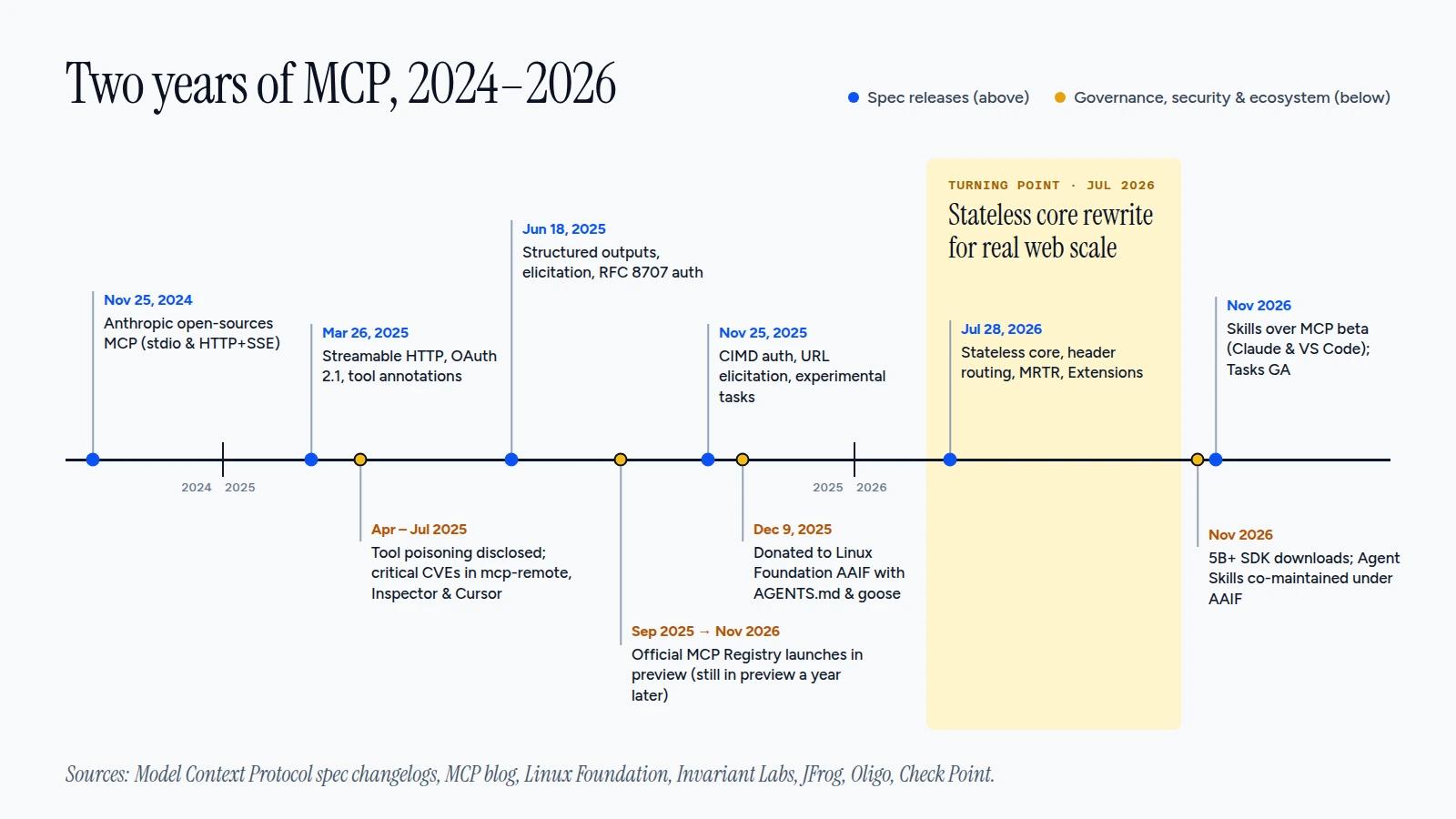
MCP shipped in late 2024 as a stateful, local-first protocol built on stdio and HTTP+SSE. Moving it to real production traffic forced four substantial spec revisions. The March 2025 release replaced HTTP+SSE with Streamable HTTP and added OAuth 2.1 and tool annotations.3 June 2025 introduced structured tool outputs, elicitation for mid-call user input, and OAuth Resource Server discovery with RFC 8707 Resource Indicators.4 November 2025 added URL-mode elicitation, OAuth Client ID Metadata Documents, OpenID Connect discovery, and experimental durable tasks.5
Together, those three releases took MCP in a single year from a local, single-user protocol to one teams could run remotely for real users, with standard auth, structured outputs, and a way to ask a person mid-task. What remained was the stateful session model underneath.
The decisive break came in the July 28, 2026 specification.6 Maintainers ripped out the initialize handshake and protocol-level sessions (Mcp-Session-Id) to make MCP stateless, so any request can hit any instance behind an ordinary load balancer. The release added server/discover, Mcp-Method and Mcp-Name headers for gateway routing, cacheable list responses, and Multi Round-Trip Requests for stateless elicitation. It also formalized an Extensions framework, moving Tasks alongside MCP Apps and Enterprise-Managed Authorization while deprecating Roots, Sampling, Logging, and Dynamic Client Registration. Discovery lagged behind the spec: the official MCP Registry, launched in preview in September 2025, still carries a preview warning about breaking changes and data resets.7
Governance went neutral
On December 9, 2025, Anthropic donated MCP to the Linux Foundation's Agentic AI Foundation (AAIF), co-founded with OpenAI (AGENTS.md) and Block (goose) and backed by AWS, Google, Microsoft, Cloudflare, and Bloomberg.8 That move mattered more to enterprise buyers than any single spec feature. It ended the debate over whether betting on MCP meant betting on one model lab.
Security became the real tax
MCP standardized how agents talk to tools, not who to trust. Four 2025 disclosures showed what that gap looks like in practice:
- Tool poisoning, rug pulls, and cross-server shadowing. In April 2025, Invariant Labs showed that instructions hidden in a tool description (which the model reads even when the user doesn't) could make an agent read
~/.ssh/id_rsaand exfiltrate it.9 A server could also rewrite its description after approval (a rug pull) or steer calls to a separate, trusted server (shadowing). - Command execution in
mcp-remote. JFrog found that connecting themcp-remoteproxy to a malicious server let the server reply with a crafted OAuth login URL that ran OS commands on the user's machine (CVE-2025-6514, CVSS 9.6).10 - Browser-to-localhost code execution in MCP Inspector. Oligo showed that Anthropic's local dev tool shipped with no authentication by default, so opening a malicious webpage could reach the local proxy and execute arbitrary commands (
CVE-2025-49596, CVSS 9.4).11 - Silent config swaps in Cursor. Check Point found that Cursor approved workspace MCP configs by name alone, letting an attacker swap the command in a shared repo after a single approval and run code silently (
CVE-2025-54136, patched in 1.3).12
Overbroad OAuth tokens raised the stakes: one compromised connector with wide scopes can expose every system behind it. The spec answered with tokens scoped to a single server (RFC 8707), issuer checks on auth responses (RFC 9207), and Enterprise-Managed Authorization.
In production, treat tool text as untrusted input, keep tokens locked to least privilege, and pin server versions so any change triggers a fresh review.
Skills, plugins, and connectors grew up beside MCP
Once teams wired dozens of MCP servers into an agent, context windows filled with tool schemas and bulky intermediate results. In November 2025, Anthropic's code execution with MCP write-up showed that discovering tools through code instead of loading every schema upfront cut token consumption sharply, and clients added on-demand tool search to control bloat.13
Tool signatures tell a model what buttons exist, not how your team runs a workflow. That gap drove the rise of Agent Skills (SKILL.md folders loaded progressively, now also stewarded inside the AAIF),14 bundled plugins that package skills with connectors and hooks, and managed SaaS connectors. Right on MCP's second anniversary, Skills over MCP reached public beta in Claude and Claude Code and landed in VS Code, letting servers ship workflow guidance alongside their tools.151617
Plumbing is not the harness
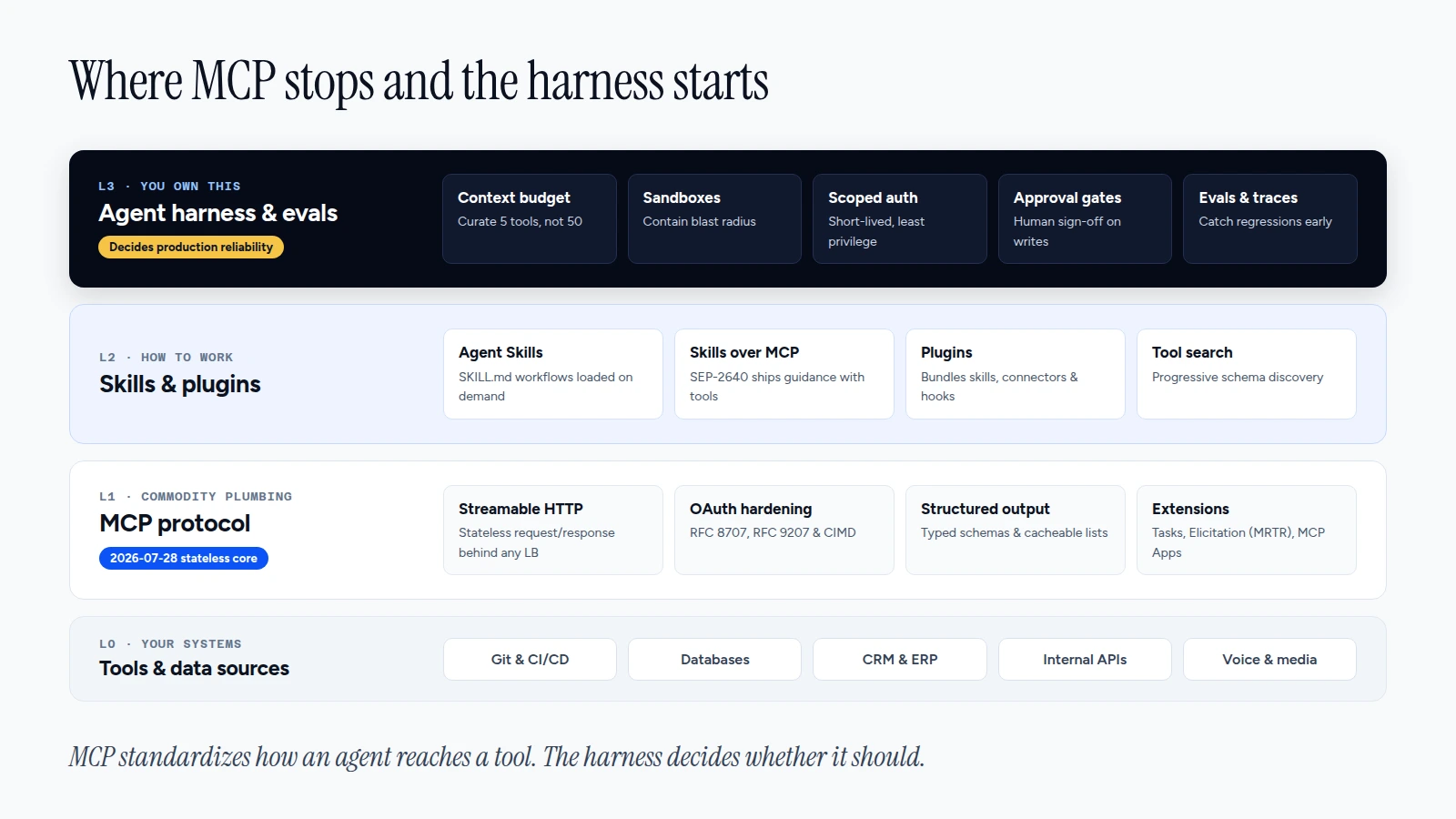
Two years of production work leave one clear rule: treat MCP as plumbing, and put your real engineering effort into the agent harness around it.
Whether we're building a software factory that runs coding agents in parallel, an internal copilot, or a voice agent, MCP removes the repetitive connector layer. What breaks production systems sits one layer up: exposing fifty tools when the task needs five, mixing untrusted external text with write credentials, skipping isolated sandboxes, or shipping without evals that catch tool-selection regressions when models change.
Look at what we built a year ago: in our December 2025 review, we described custom MCP servers for internal codebase search, API docs, and BI database exploration. Over 2026, we migrated those internal knowledge servers onto the newer spec. We moved them to stateless Streamable HTTP so they ran as remote services instead of local installs, and switched to OAuth with Enterprise-Managed Authorization so each engineer got their own access instead of shared tokens. We adopted structured outputs and cacheable list responses, moved SQL conventions and repo playbooks into skills, and added elicitation over Multi Round-Trip Requests alongside Tasks for expensive queries. Three things changed. Adoption grew across engineers and agents once local setup was gone. Knowledge started compounding, because each new playbook or skill was reused across projects and agents instead of staying trapped in one prompt. And security tightened: access became per-user, scoped, and auditable, with no shared tokens and a human confirmation before expensive or sensitive queries ran.
Where to invest heading into year three
Going into 2027, adopt MCP as your default integration layer, build new remote servers on the stateless 2026-07-28 spec, keep every server narrow and read-only until you have approval gates, and put workflow guidance in skills instead of bloated tool descriptions. Put the rest of your effort into the harness and evals that decide whether an agent workflow holds up in production.
If you're working through how MCP, skills, and harness architecture fit your own stack, we're happy to compare notes.
References
Footnotes
-
Anthropic. Introducing the Model Context Protocol, November 25, 2024. ↩
-
Model Context Protocol Blog (David Soria Parra, Den Delimarsky). Two Years of MCP Builders, November 24, 2026. ↩
-
Model Context Protocol Specification. Key Changes (2025-03-26), March 26, 2025. ↩
-
Model Context Protocol Specification. Key Changes (2025-06-18), June 18, 2025. ↩
-
Model Context Protocol Specification. Key Changes (2025-11-25), November 25, 2025. ↩
-
Model Context Protocol Blog (David Soria Parra, Den Delimarsky). The 2026-07-28 Specification, July 28, 2026. See also the 2026-07-28 specification changelog. ↩
-
Model Context Protocol Documentation. The MCP Registry. ↩
-
Linux Foundation. Linux Foundation Announces the Formation of the Agentic AI Foundation (AAIF), December 9, 2025. ↩
-
Invariant Labs (Luca Beurer-Kellner, Marc Fischer). MCP Security Notification: Tool Poisoning Attacks, April 1, 2025. ↩
-
JFrog Security Research. Critical RCE Vulnerability in mcp-remote: CVE-2025-6514 Threatens LLM Clients, July 9, 2025. ↩
-
Oligo Security (Avi Lumelsky). Critical RCE Vulnerability in Anthropic MCP Inspector - CVE-2025-49596, June 27, 2025. ↩
-
Check Point Research. CVE-2025-54136 – MCPoison Cursor IDE: Persistent Code Execution via MCP Trust Bypass, August 5, 2025. ↩
-
Anthropic Engineering (Adam Jones, Conor Kelly). Code execution with MCP: Building more efficient agents, November 4, 2025. ↩
-
Google Open Source Blog (Kurtis Van Gent, Daryl Ducharme). Scaling AI agents with open standards: Kurtis Van Gent on MCP and Agent Skills joining the AAIF, November 11, 2026. ↩
-
Model Context Protocol Documentation. Skills (
io.modelcontextprotocol/skills, SEP-2640). ↩ -
Anthropic. MCP servers can now ship skills, run tasks, and more with Claude, November 24, 2026. ↩
-
Microsoft Community Hub (Pamela Fox). Skills over MCP are now available in VS Code, November 18, 2026. ↩