Agentic Commerce in 2026: How to Win the Agentic Shift
Agentic commerce is turning your next customer into software. Here are the four engineering workstreams (catalog data, semantic search, conversational AI, agent-facing protocols) that decide who gets chosen in 2026, and how to sequence them.
Leonardo Piñeyro
CTO
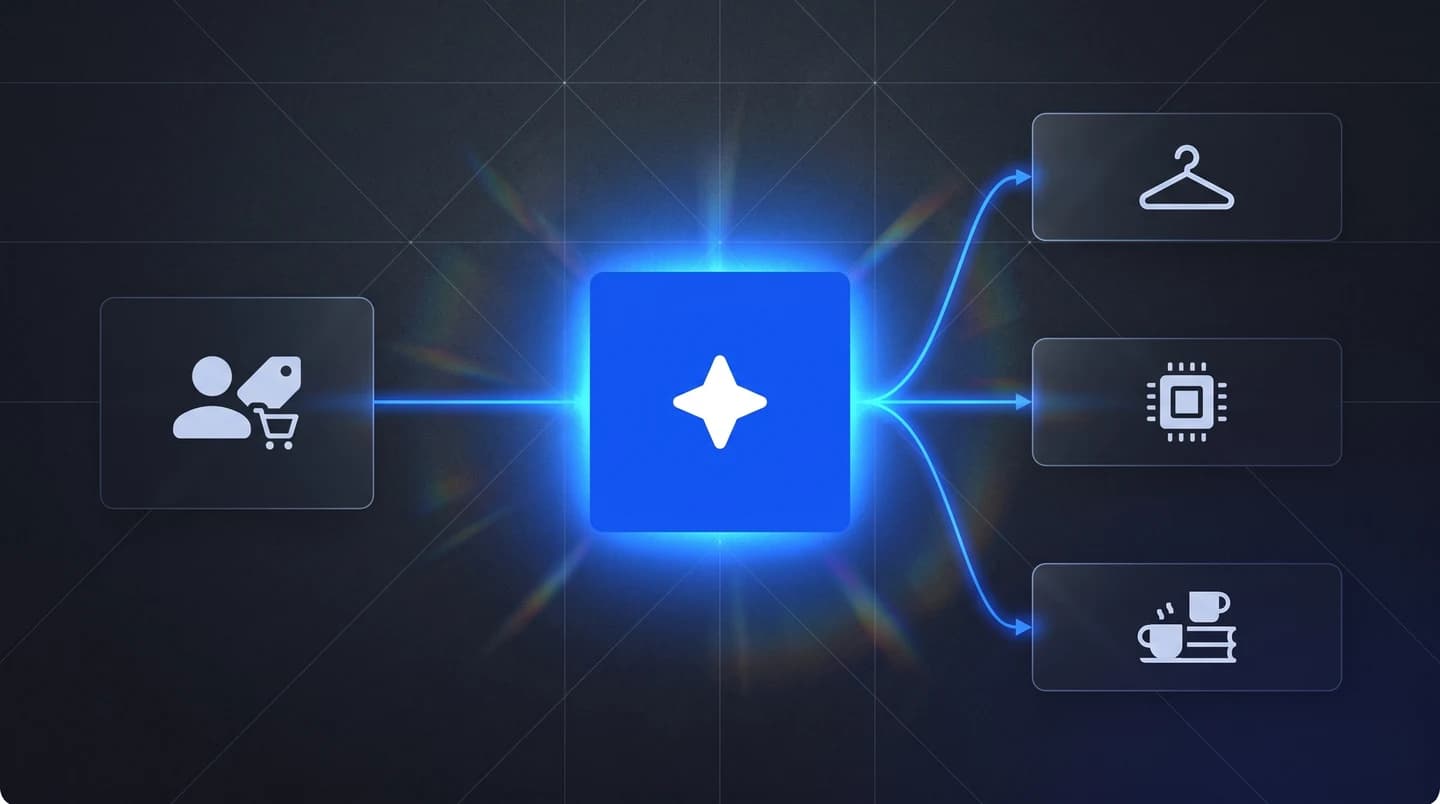
For 20 years, ecommerce optimization meant making it easier for a human to browse, decide, and click buy. That assumption is breaking. Agentic commerce (AI agents shopping on behalf of humans) is turning your next customer into software. In 2026, a growing share of buyers won't browse at all. An agent will interpret their intent ("trail running shoes, under $150, delivered by Friday"), evaluate offers across merchants, and complete the purchase. The human sets the parameters. The agent does the shopping.
Most of what gets sold as "AI in ecommerce" today (copy generators, ad optimizers, campaign tools) has nothing to do with winning in that world. Engineering will decide the winners: structured catalogs, search that understands meaning, conversational systems that resolve problems instead of deflecting them, and APIs an agent can transact against. This post breaks that work into four concrete workstreams, sequenced so the first is the part a head of ecommerce owns.
The shift: Your next customer might be an agent
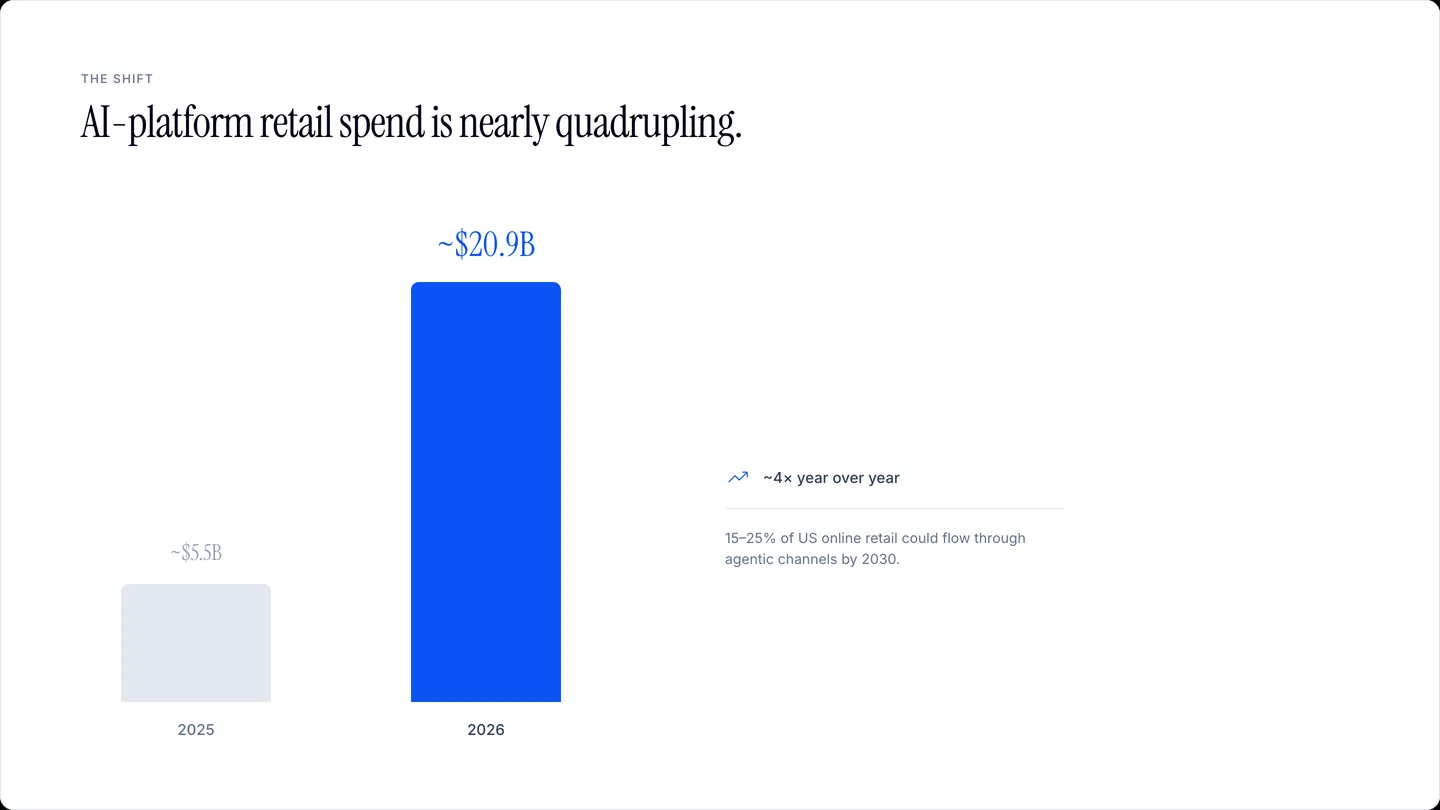
The numbers moved fast this year. AI platforms will account for roughly $20.9 billion in retail spending in 2026, nearly quadrupling 2025's figure, according to eMarketer.1 McKinsey estimates agentic commerce could redirect $3–5 trillion in global retail spend by 2030,2 and Bain projects 15–25 percent of U.S. online retail sales could flow through agentic channels by the end of the decade.3
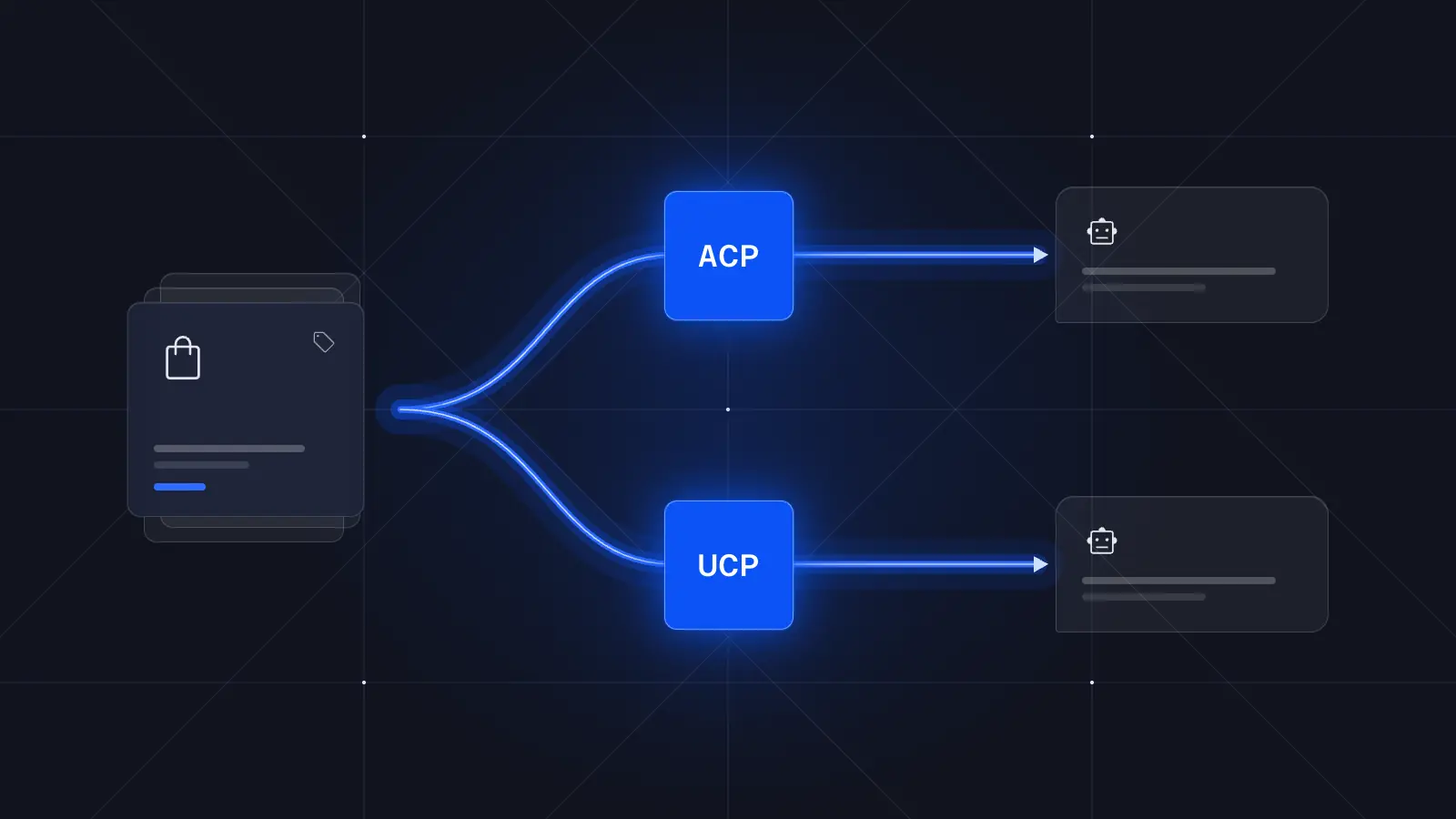
The infrastructure landed, too. At NRF in January 2026, Google announced the Universal Commerce Protocol (UCP), an open standard co-developed with Shopify and retailers including Walmart, Target, and Etsy that lets AI agents discover products, manage carts, and complete orders against any merchant that speaks it.4 OpenAI's Agentic Commerce Protocol (ACP), built with Stripe, already powers checkout flows with Instacart, DoorDash, Shopify, and Etsy.5
Microsoft Copilot Checkout is live in the U.S. Amazon is expanding Rufus and "Buy for me." Shopify's Agentic Storefronts let a single merchant sell inside ChatGPT, Copilot, and Gemini simultaneously. If 2025 was the year of MCP (we covered that arc in "A Year of MCP"), 2026 is the year the same protocol logic reached the checkout.
Demand is real, autonomy is early, and the gap between the two is an infrastructure problem. That's good news, because infrastructure problems are solvable, and the merchants who solve them first get chosen first.
Why bolting AI features onto the funnel falls short
The instinct most teams follow is to add AI at the edges. A chatbot widget from the support vendor. AI-generated product descriptions. A "recommended for you" carousel from a plug-and-play personalization tool. Each one demos well, but none of them addresses the structural change.
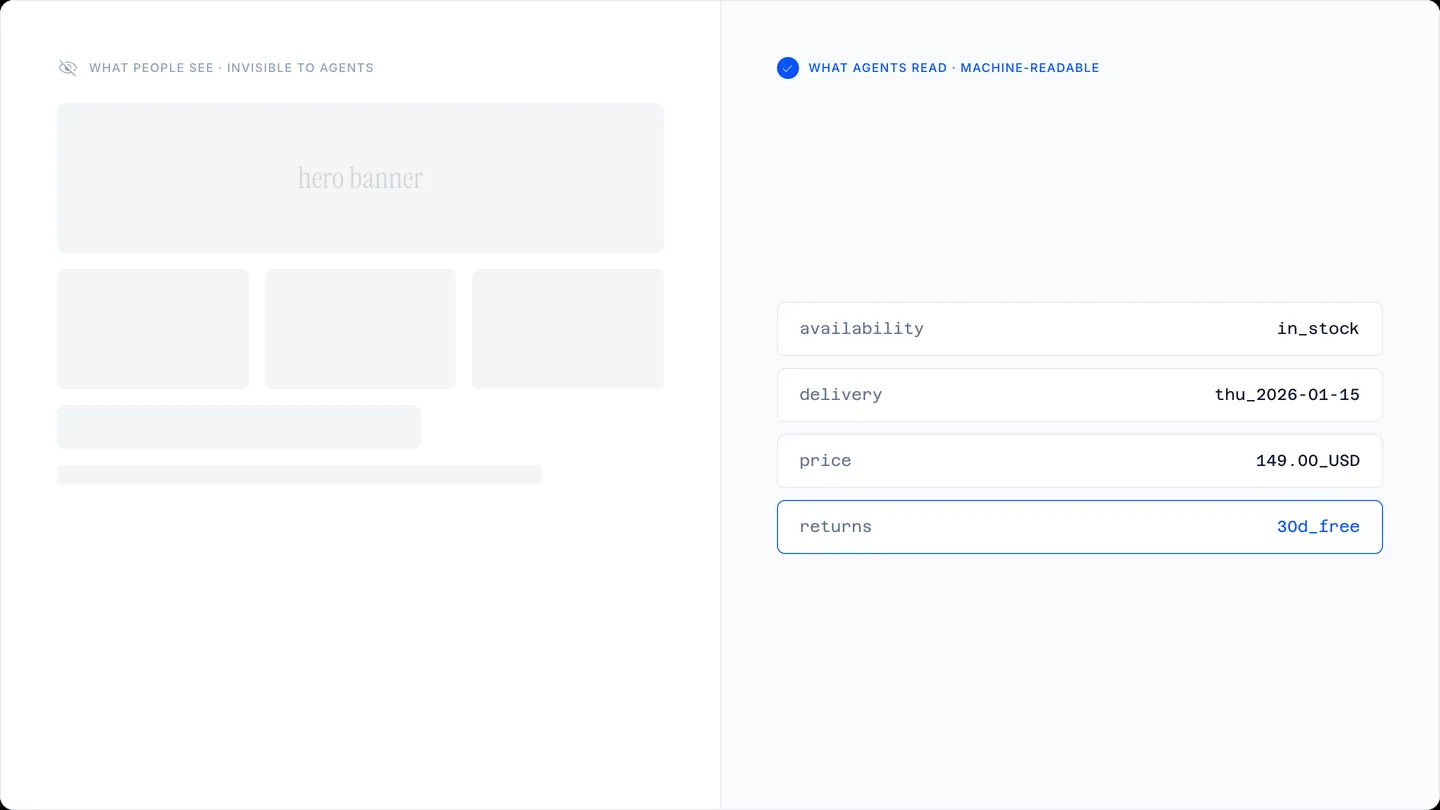
The structural change is that an AI agent doesn't see your visual merchandising, your hero banner, or your brand storytelling. It reads structured data. When an agent compares two merchants selling the same product at the same price, it picks the one whose availability, delivery windows, pricing, and returns terms are machine-readable, consistent, and reliable. If that information is missing or contradictory across channels, the agent can skip your offer without a human ever seeing it.6 The industry term is agent legibility: Your store now needs to be selectable by software, not just attractive to people.
There's a second problem: measurement. In agent-mediated commerce, discovery, comparison, and consideration all happen inside the AI conversation. Your analytics stream starts at add-to-cart, if you're lucky. Attribution collapses, personalization signals thin out, and the funnel you've spent a decade instrumenting goes partially dark.7 A tool bolted onto the storefront can't fix a data layer that agents can't read.
That makes agentic commerce a product and engineering problem, not a marketing one.
The four agentic commerce workstreams that decide who wins
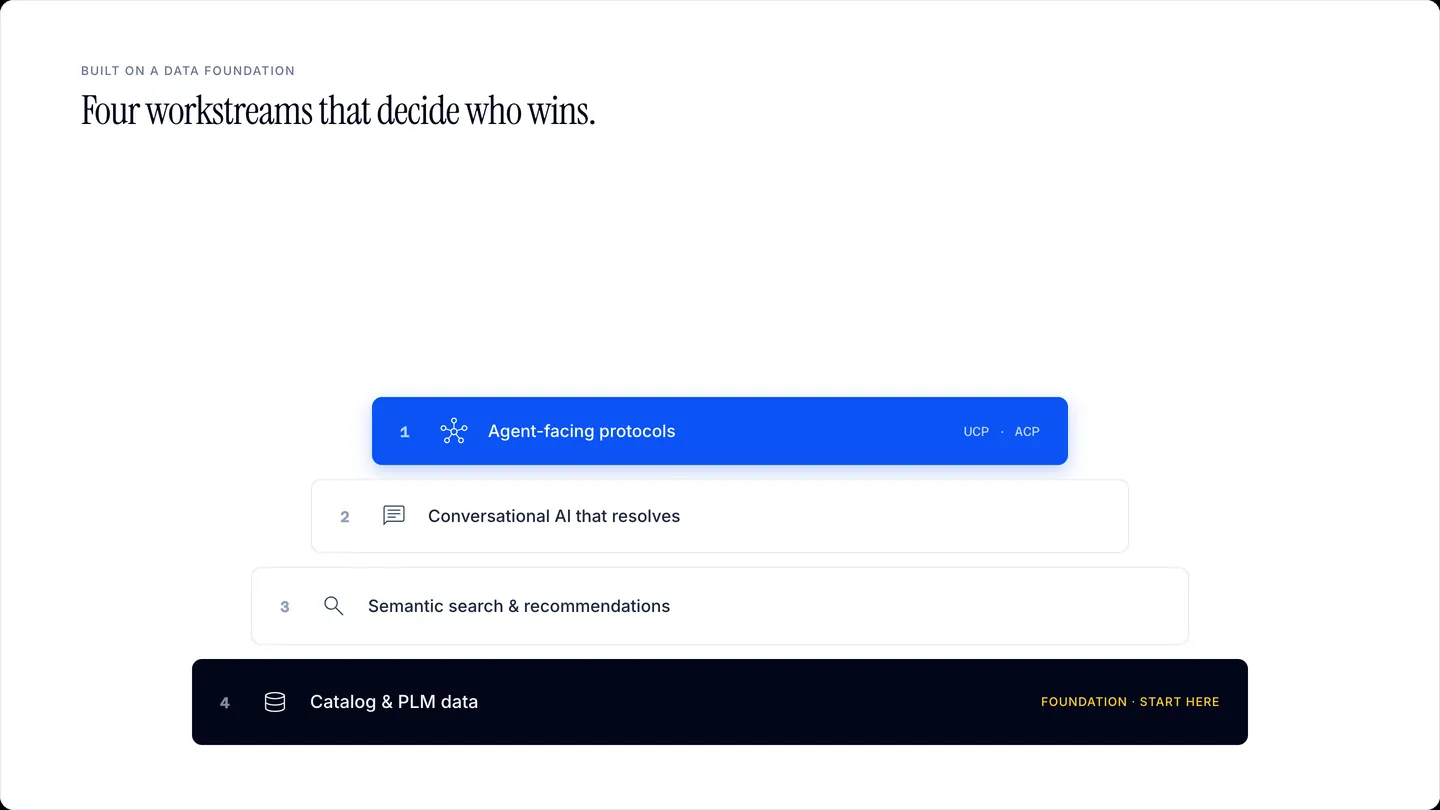
1. Agentic commerce readiness
Agentic readiness is the newest workstream and the one with the clearest first-mover dynamics. Getting ready means exposing product, pricing, inventory, and fulfillment data through clean APIs, adopting or preparing for protocols like UCP and ACP, and making sure the answers an agent needs ("Can this arrive Thursday?" "What's the return window?") are structured and queryable rather than buried in page copy.8
It also means rethinking trust and security. Financial institutions expect fraud pressure from agent traffic, and standards for authenticating legitimate shopping agents (so-called Know Your Agent approaches, including cryptographic signature headers) are taking shape this year.9 Your checkout needs to distinguish a customer's authorized agent from a scraper, and your fraud models need recalibration, because agents legitimately behave in ways that look suspicious to rules built for humans.
The practical rule of thumb: If your delivery options and product attributes are rendered only as page elements, they're invisible to agents. Start there.
Kill criteria: If your product data can't survive an API audit (attributes missing, prices inconsistent across channels), protocol integration is premature. Fix the data layer first (workstream 4).
2. Conversational AI that resolves, not deflects
Conversational AI for ecommerce has been around long enough to have a reputation, and the reputation is mostly deserved: decision-tree chatbots that deflect tickets and frustrate customers. The 2026 version is a different animal. Built on LLMs with access to your order management system, catalog, and policies, a conversational agent can check a real order status, process an exchange within policy, answer a sizing question against actual product specs, and hand off to a human with full context when it hits its limits.
What separates the two is the engineering around the model: retrieval over your actual product and policy data, guardrails on what actions the agent can take autonomously, and evaluation suites that measure resolution rate, not deflection rate. We wrote about that production discipline in depth in our agents recipe book, and everything there applies doubly here, because this agent talks to your customers with your brand's name on it. It's the same conversational AI engineering we apply across industries. Ecommerce raises the stakes.
Done right, conversational AI is also your hedge on the discovery shift. If shoppers increasingly prefer conversational interfaces, the merchants offering a genuinely useful one on their own properties keep the relationship (and the data) that agent-mediated channels take away. After underperforming in ChatGPT checkout, Walmart put its own assistant, Sparky, inside ChatGPT rather than cede the conversation entirely.10
3. Semantic search and recommendations
Search is where the money leaks quietly. Every query that returns "no results" for a product you stock, every keyword mismatch between how customers talk and how your catalog is written, is margin walking out the door. Semantic search fixes the whole category of problem: Instead of matching keywords, you encode the meaning of each query into an embedding and find the nearest products in vector space. "Something warm for hiking in the rain" finds the right jacket even though none of those words appear in the product title.
Semantic retrieval matters more, not less, in the agent era. When an AI agent queries your catalog on a shopper's behalf, it asks in natural language with rich constraints. A keyword engine gives it a worse answer than your competitor's semantic one, and the agent notices. McKinsey's data already shows AI-generated product recommendations converting at 4.4 times the rate of traditional search.11 The retrieval quality of your catalog is now a selection criterion, not just a UX nicety. Upgrading it is core search and recommendations engineering, and it typically pays back within a quarter.
4. Catalog and PLM automation
The least glamorous workstream and, in our experience, the one with the fastest payback. The other three workstreams all depend on product data: complete attributes, consistent taxonomies, accurate specs, quality images. In most ecommerce operations, that data is produced by a slow, manual pipeline stretching from supplier feeds through PLM systems to the storefront, and it's full of holes.
Cleaning it up is exactly the kind of dirty work modern AI handles well: extracting structured attributes from supplier PDFs and images, normalizing inconsistent category trees, generating and validating product descriptions against source specs (with human review where accuracy is critical), flagging gaps and contradictions before they hit the storefront, and computer vision for tagging visual attributes at scale. None of it makes a flashy demo, but all of it compounds, because clean, complete, machine-readable product data is the raw material for search, recommendations, conversational AI, and agent selection alike. Gartner predicts 40 percent of enterprise applications will embed AI agents by 2026, and agents amplify every data-quality issue you already have.12
The teams that treat catalog data as a product (with pipelines and quality gates) are the ones whose "AI features" work downstream.
How to sequence the agentic commerce work
You don't need all four workstreams at once, and the right order depends on where your gaps are. But a sensible default exists.
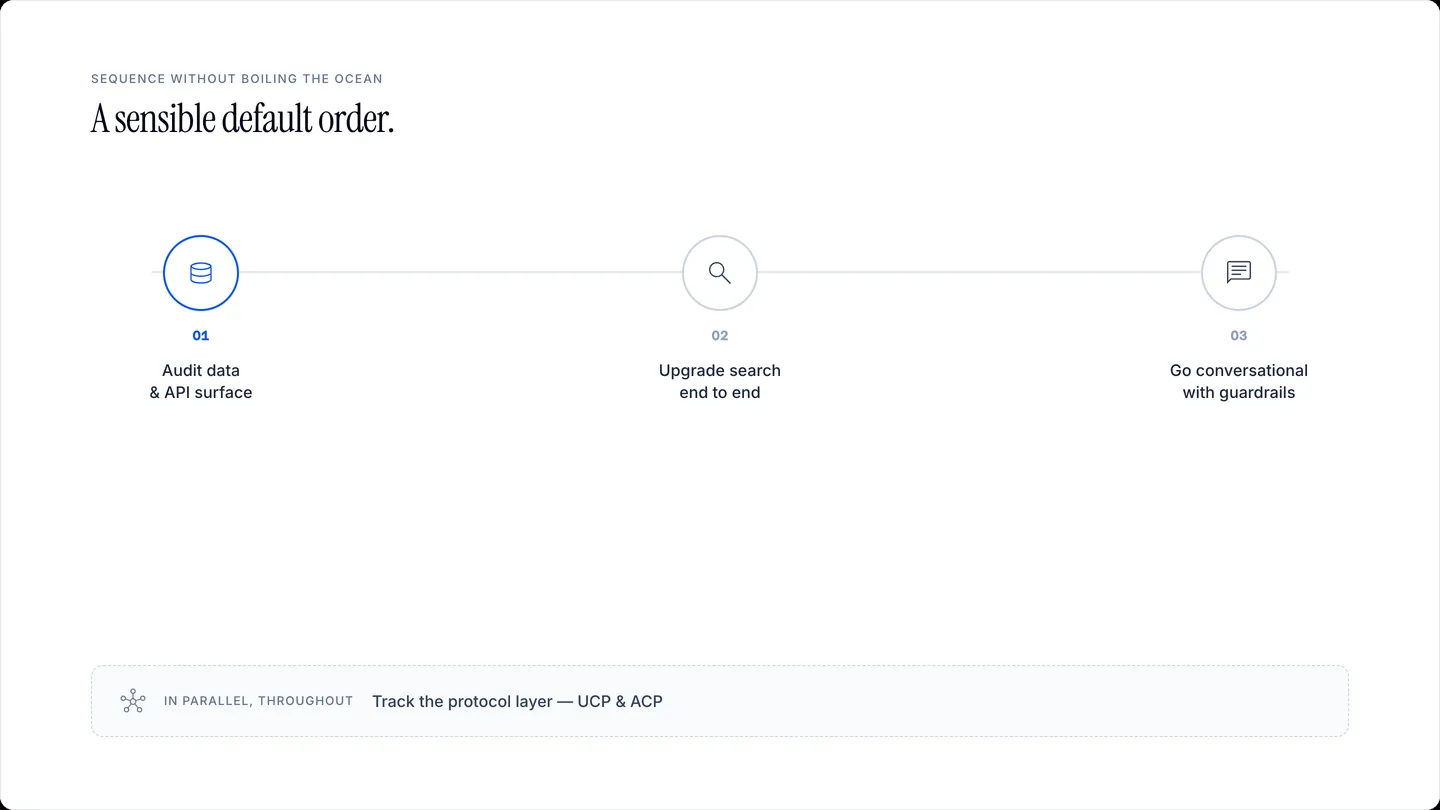
Start with the data foundation. Audit your catalog completeness and your API surface. If an agent queried your store today, what could it learn and do? This audit is cheap, and it usually reveals that catalog automation and API work should come before anything customer-facing.
Then upgrade one revenue-adjacent system end to end, usually search, because the ROI is measurable within a quarter and the same embedding infrastructure powers recommendations and conversational retrieval later.
Then go conversational, with the production discipline the recipe book describes: evals before the agent, bounded autonomy, human escalation paths. The gap between a demo and a production system is real. We've written about what it takes to go from research to production, and the same discipline applies here.
And in parallel, track the protocol layer. UCP and ACP are moving quickly, and integration cost is dropping as platforms like Shopify bake them in. Being early here is cheap; being late means invisibility in a channel that's compounding. For how the two protocols differ and which to build for first, see our ACP vs UCP breakdown.
These investments hedge each other. If autonomous purchasing takes longer to mature than the projections say (and the paused pilots suggest some of it will), you've still built better search, better support, and a cleaner catalog. There's no scenario where that work is wasted.
What this means for your roadmap
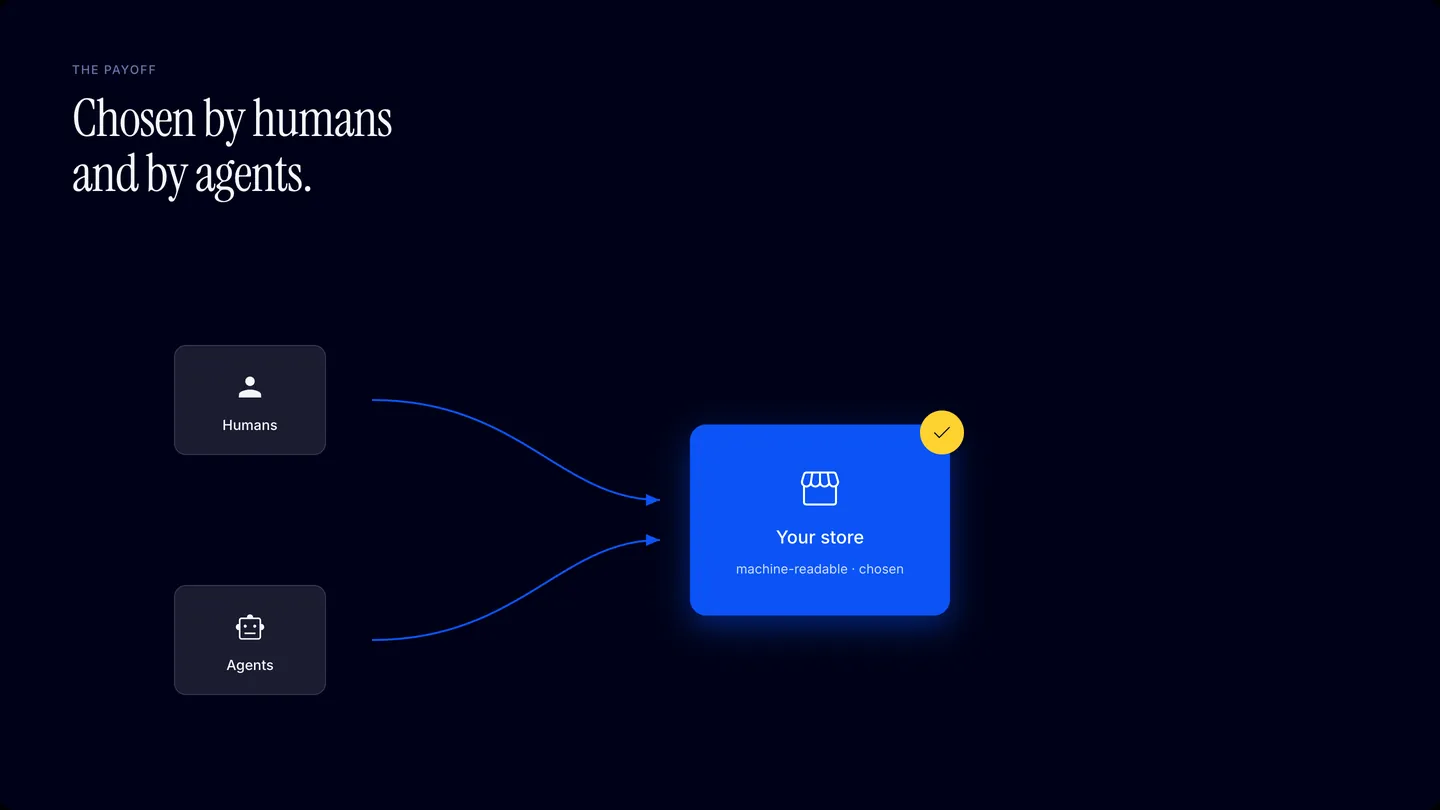
Agentic commerce is an engineering posture, not a feature you buy from a marketing vendor: machine-readable data, retrieval that understands meaning, agents with guardrails, and APIs that let the new commerce channels transact with you. The merchants who treat it that way get chosen by humans and by agents. The ones who treat it as a widget shopping spree get skipped silently.
That's the part we love working on. At Pento we've spent years building search, conversational AI, and data automation systems for ecommerce and retail clients (including work with Mercado Libre, one of the largest ecommerce platforms in the world), and we're deep in agentic commerce development right now. If you're mapping where this fits on your roadmap, start with our free ecommerce audit or book a call to compare notes on your agent readiness.
Footnotes
Footnotes
-
How AI Agents Are Changing E-commerce in 2026: Open Protocols Explained, Ekamoira, citing eMarketer, Dec 2025. ↩
-
Agentic commerce in 2026: Why delivery decides who wins, nShift, citing McKinsey. ↩
-
Agentic Commerce Trends and Statistics for 2026, MetaRouter. Bain projection, 4.4x conversion figure, attribution gap, Know Your Agent. Vendor-synthesized figures; treat as directional. ↩
-
5 Agentic Commerce Trends Every Retail Leader Must Know in 2026, Tredence. UCP announcement at NRF, Jan 2026. ↩
-
Agentic commerce in 2026, nShift. ACP partners. ↩
-
The rise of agentic commerce, nShift. Agent legibility. ↩
-
Agentic Commerce Trends and Statistics for 2026, MetaRouter. Bain projection, 4.4x conversion figure, attribution gap, Know Your Agent. Vendor-synthesized figures; treat as directional. ↩
-
Agentic Commerce Stats 2026: Enterprise Guide, commercetools. Machine-readable commerce layer, Gartner prediction. ↩
-
Agentic Commerce Trends and Statistics for 2026, MetaRouter. Bain projection, 4.4x conversion figure, attribution gap, Know Your Agent. Vendor-synthesized figures; treat as directional. ↩
-
The Agentic Commerce Radar: Key Insights for 2026, commercetools. Instant Checkout pause, Walmart conversion, Sparky. ↩
-
Agentic Commerce Trends and Statistics for 2026, MetaRouter. Bain projection, 4.4x conversion figure, attribution gap, Know Your Agent. Vendor-synthesized figures; treat as directional. ↩
-
Agentic Commerce Stats 2026: Enterprise Guide, commercetools. Machine-readable commerce layer, Gartner prediction. ↩